
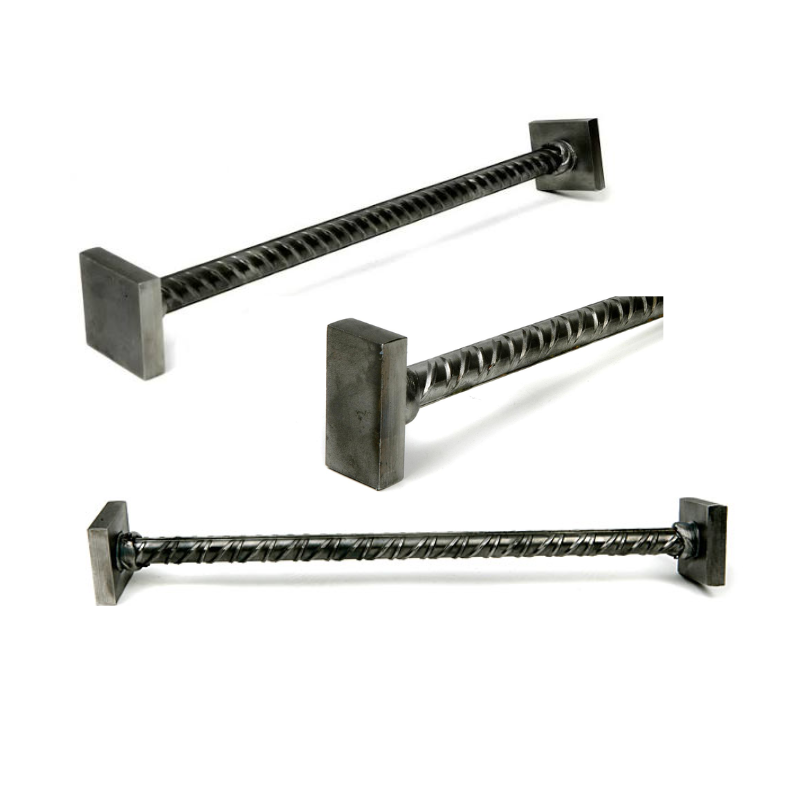
T-head Rebar — Heavy Duty Headed Reinforcing Bars for Concrete Anchorage
Headed Bars with T-Head Anchor Plates — Therefore, our engineers design these T-head rebar systems to replace traditional hooks, reduce rebar congestion, and provide superior anchorage in beam-column joints, pile caps, and shear walls.

What Is T-head Rebar (Headed Reinforcing Bars)?
Furthermore, we manufacture our T-head rebar system in accordance with ACI 318 provisions. Consequently, contractors widely use it in heavily reinforced concrete elements where traditional hook anchorage would cause severe rebar congestion, honeycombing, and construction delays. By replacing 90° or 180° hooks with a compact head plate, we help contractors improve concrete flow, reduce steel congestion, and accelerate construction schedules.
Key Benefits of T-head Rebar vs. Traditional Hooked Bars
-
Superior Anchorage Strength
For example, pull-out tests demonstrate that T-head rebar achieves 8.5% higher anchorage strength than conventional 180° hooked bars under identical conditions. Therefore, the T-head anchor plate mobilises full bar tensile strength through bearing, independent of bond stress alone.
-
Reduced Rebar Congestion & Improved Concrete Flow
However, traditional hooks consume significant space in beam-column joints and pile caps, leading to rebar congestion. In contrast, our headed reinforcing bars eliminate bends and hooks. Consequently, they provide more space for concrete placement and ensure proper consolidation.
-
Shorter Development Length
Moreover, the compact head plate design significantly reduces required development length compared to hooked bars. As a result, code provisions may allow elimination of bonded anchorage length altogether, simplifying design and detailing.
-
Faster & More Economical Construction
In addition, straight rebar with headed ends is easier to transport, handle, and fix on-site than bent rebar. Thus, contractors save time and labour costs while achieving rapid construction programmes for heavily loaded structures.
Typical Applications of T-head Rebar
Consequently, engineers widely specify our mechanical anchorage system for:
- Beam-Column Joints — Specifically, T-shaped and exterior joints at middle floors and rooftops
- Pile Caps & Foundations — Particularly heavy-loaded wall and foundation applications where large shear reinforcement is required
- Precast Concrete Connections — For instance, overlapping headed bars for continuity over short splice lengths. (See our Rebar Couplers for splicing solutions)
- Flat Slab Column Heads — Notably, localised high shear stress zones around column heads. (Explore our Shear Studs for punching shear reinforcement)
Technical Specifications
| Parameter | Specification |
|---|---|
| Product Type | T-head rebar / headed reinforcing bars / headed bars |
| Head Plate Net Area | 4× – 9× rebar cross-sectional area (per ACI 318) |
| Rebar Diameter Range | 12 mm – 40 mm (custom sizes available) |
| Steel Grade | HRB400 / HRB500 / B500B / ASTM A615 Gr.60/75 |
| Standard Compliance | Complies with ACI 318, BS 8666, EN 1992-1-1, ISO 6935 |
Frequently Asked Questions About T-head Rebar
What is the difference between T-head rebar and traditional hooked rebar?
While traditional hooked rebar relies on a 90° or 180° bend and a long development length to achieve anchorage, T-head rebar uses a compact head plate at the bar end. Consequently, it achieves anchorage through bearing against concrete. Therefore, this eliminates rebar congestion, reduces development length, and improves concrete flow in heavily reinforced joints.
What head plate size is required for ACI 318 compliance?
Specifically, ACI 318 mandates that the net area of the head plate must be at least 4 times the rebar cross-sectional area. Furthermore, for enhanced anchorage performance, we offer head plates up to 9 times the rebar area.
Request a Quote for T-head Rebar
Therefore, whether you are designing a beam-column joint, pile cap, or shear wall reinforcement system, our engineering team can help you specify the right T-head rebar configuration. Contact us for technical data sheets, ACI 318 compliance documentation, and competitive pricing.