
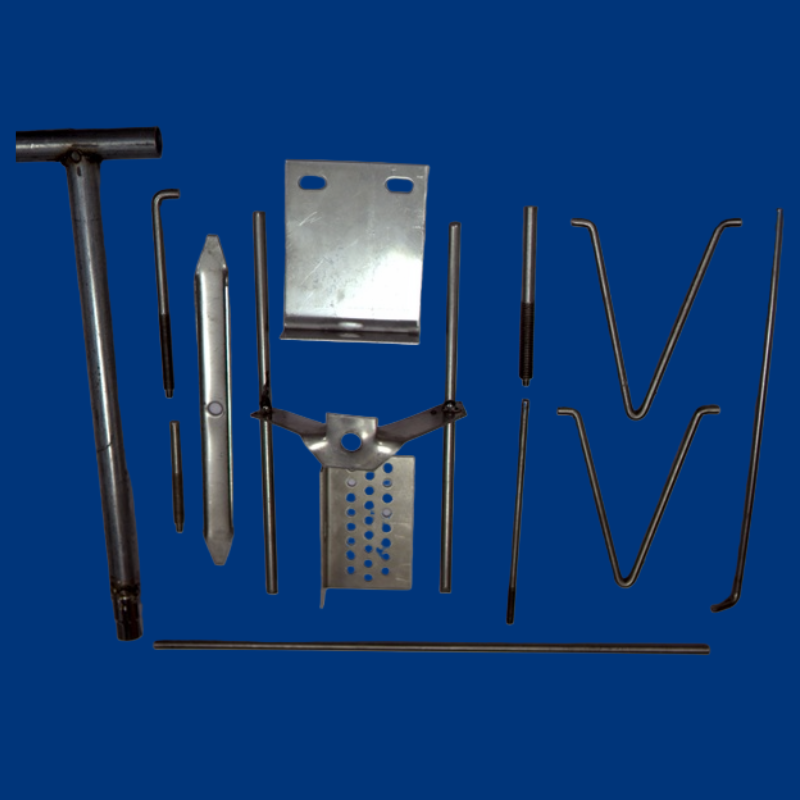
In addition, we produce these prefabricated ceramic fiber modules in standard 1260°C, high-purity 1260°C, high-alumina 1360°C, and zirconia 1430°C grades, paired with Weld-Loc, Power-Loc, and Thread-Loc refractory anchor systems. Meanwhile, we comply with ASTM C892 and EN 1094-1. Therefore, engineers and contractors rely on them for rapid furnace lining installation with low heat storage and excellent thermal shock resistance.

Technical Specifications of Ceramic Fiber Module Refractory Anchors
To begin with, we manufacture our ceramic fiber modules in a range of grades, densities, and anchor configurations. Specifically, the table below summarizes the standard product range.
| Grade | Classification Temp. | Al₂O₃ (%) | ZrO₂ (%) | Density (kg/m³) | Typical Application |
|---|---|---|---|---|---|
| Standard | 1260°C | 44 – 46 | — | 128 / 160 | General furnace backup insulation |
| High Purity | 1260°C | 47 – 49 | — | 128 / 160 | Petrochemical heater linings |
| High Alumina | 1360°C | 52 – 55 | — | 160 / 192 | Steel reheating furnace linings |
| Zirconia | 1430°C | 39 – 40 | 15 – 17 | 160 / 192 | Severe high temperature furnace linings |
Material & Physical Specifications for Refractory Anchor Modules
- To begin with, we use high-purity alumina-silicate raw materials as the base for our ceramic fiber modules. The fiber is produced by melting and blowing or spinning, then needle-punched to form a flexible blanket before being folded or stacked into modules.
- Moreover, our modules have a standard density of 128 kg/m³, 160 kg/m³, or 192 kg/m³, depending on the grade and application requirements.
- Additionally, we manufacture standard module sizes of 300 × 300 × 300 mm and 305 × 305 × 305 mm. Custom sizes are available on request.
- Furthermore, our modules achieve a permanent linear shrinkage of less than 2.5% (24-hour holding, based on 128 kg/m³ density).
- For special orders, we supply aluminum foil faced and stainless steel wire reinforced ceramic fiber modules for enhanced surface protection.
- Finally, we offer OEM & ODM — we customize density, module dimensions, temperature grade, anchor system, and packaging according to your specifications.
Weld-Loc, Power-Loc & Thread-Loc Refractory Anchor Systems
In fact, ceramic fiber modules are prefabricated insulation blocks made by folding or stacking ceramic fiber blanket into compressed modules and securing them with built-in refractory anchors. Furthermore, the compressed construction allows modules to expand slightly after untying, closing joints between blocks and reducing hot spots and through-gaps. Therefore, the modular design delivers faster installation, reduced shrinkage, and lower heat storage compared to traditional layered linings.
In addition, the module is secured to the metallic anchor using a pair of stainless steel support tubes, with flanges on the tube ends locking the module position relative to the anchor during installation[reference:0]. Meanwhile, the anchor system stays remote from the module hot face, maintaining metal components at a relatively low temperature[reference:1].
Anchor System Comparison
| Anchor System | Installation Method | Key Advantages | Best Application |
|---|---|---|---|
| Weld-Loc | Special weld stud assembly fused to furnace casing; hex nut torqued to draw module to casing plate[reference:2] | High installation speed; random placement; positive torque test of welds[reference:3] | Standard furnace wall and roof linings |
| Power-Loc | Hardened steel pin mechanically secured to steel casing plate using powder-actuated fastening tool[reference:4] | No casing preparation required; permits random placement; fast installation | Applications where welding is impractical |
| Thread-Loc | All-thread weld stud and flanged nut installed on prepositioned stud pattern[reference:5] | Compatible with mastic coatings, backup insulation, and foil vapor barriers; compensates for stud placement variations[reference:6] | Linings requiring backing insulation or corrosion treatment |
Furthermore, we also supply Y-type, M-type, and T-type module configurations. Specifically, the Y module connects the support tubes with a central internal yoke and installs directly onto the metal plate casing without pre-welding, offering the fastest installation rates[reference:7]. Moreover, the M module fits onto pre-welded studs, and the T module uses a pre-studded external side-fix yoke, allowing use of backing insulation and casing treatment[reference:8].
Why Choose Our Ceramic Fiber Module Refractory Anchors?
In fact, ceramic fiber modules are the industry standard for high-temperature insulation because they offer low thermal conductivity, low heat storage, and excellent thermal shock resistance. Furthermore, the prefabricated modular design significantly reduces installation time compared to traditional brick or monolithic linings.
- First, our modules offer low heat storage. The low mass and porous microstructure reduce thermal storage, helping furnace linings reach operating temperature faster and lowering fuel or power consumption per batch.
- Second, they provide faster installation. Pre-compressed modules with integrated refractory anchors can be quickly fastened to the furnace shell, reducing labor costs.
- Third, they deliver reduced shrinkage compared to layered lining construction, ensuring long-term lining integrity.
- Fourth, they ensure excellent thermal shock resistance. The fiber-based structure tolerates frequent heating and cooling cycles better than many brick or monolithic linings.
- Finally, they provide superior thermal stability. The resilient blanket is resistant to mechanical damage and can be easily cut on-site to suit awkward configurations.
Applications & Industries for Ceramic Fiber Module Refractory Anchors
- For instance, in petrochemical heaters and reformers, our modules insulate process heaters, ammonia reformers, and crude oil heaters at temperatures up to 1430°C.
- Also, in steel industry furnaces, they line stress relieving furnaces, annealing furnaces, carbottom heat treating furnaces, and reheat furnaces[reference:9].
- In addition, for kilns and ceramic kilns, they provide reliable insulation for shuttle kilns, tunnel kilns, and brick kilns.
- Furthermore, in glass industry furnaces, they insulate furnace walls and roofs for energy efficiency.
- Lastly, in incineration equipment and stack linings, they protect against high-temperature gases and thermal cycling.
About Our Factory — Direct Manufacturer of Ceramic Fiber Module Refractory Anchors
In fact, Tarco Industry operates a modern manufacturing facility. Specifically, we dedicate it to the production of ceramic fiber modules and refractory anchor systems.
Furthermore, we complete every step in our own factory. This includes raw material melting, fiber blowing, needle punching, module folding, anchor assembly, and packaging. Consequently, we do not outsource production. We do not act as a middleman.
In addition, we equip our factory with advanced melting furnaces and automated module assembly lines. As a result, we produce high-quality ceramic fiber modules with consistent fiber diameter, uniform density, and reliable thermal performance.
Therefore, whether you need standard 1260°C or zirconia 1430°C modules with Weld-Loc, Power-Loc, or Thread-Loc anchors, Tarco Industry can produce them directly for you.
Factory Direct Advantages
- First, we are a Manufacturer, Not a Trader. You buy directly from Tarco Industry production lines, eliminating middleman markups.
- Second, we handle In-House Production. We produce fiber, modules, and refractory anchors all under one roof for full quality control.
- Third, we welcome OEM & ODM. We customize density, module dimensions, temperature grade, anchor system, and packaging.
- Fourth, we maintain Bulk Production Capacity. We ensure stable output for large furnace and kiln projects.
- Finally, we provide Factory Price. We offer competitive direct pricing for distributors, refractory contractors, and OEMs.
How to Install Ceramic Fiber Modules with Refractory Anchors
- First, prepare the furnace shell surface. Clean the steel shell to remove rust, scale, oil, and moisture. Ensure the surface is suitable for welding or mechanical fastening.
- Then, install the refractory anchors. Weld or fasten the module anchors to the furnace shell in the specified pattern (usually 200–300 mm spacing)[reference:10]. For Weld-Loc systems, weld the stud assembly to the casing. For Power-Loc systems, use a powder-actuated tool to secure the anchor pin.
- Next, position the module. Place the ceramic fiber module onto the anchors and compress it against the furnace shell.
- After that, secure the module. Tighten the fastener or nut to draw the module firmly against the casing plate. The module will expand slightly after untying, closing joints between adjacent modules.
- Finally, verify the installation. Check that all modules are securely fastened, joints are tight, and the lining surface is level and uniform.
Quality Assurance & Certifications
Furthermore, Tarco Industry manufactures our ceramic fiber modules and refractory anchors under strict quality control. Specifically, they comply with ASTM C892, EN 1094-1, and ISO 10635 standards.
As a result, we perform density testing, tensile strength testing, thermal conductivity testing, linear shrinkage testing, and chemical composition analysis. Moreover, we test every production batch before shipment.
- Additionally, we offer certifications including ISO 9001, CE, and SGS.
- Similarly, our production capacity reaches 300 tons per month.
- Also, we set the MOQ at 500 pcs (negotiable for sample orders).
- In terms of packaging, we offer plastic bags inside cartons or woven bags, on pallets with custom marking.
- Finally, we deliver within 15–20 business days after order confirmation.
Request a Quote for Ceramic Fiber Module Refractory Anchors
In conclusion, we are Tarco Industry. We are a direct manufacturer of high temperature ceramic fiber modules and refractory anchor systems.
Therefore, because we produce in our own factory, we offer competitive factory-direct pricing. In other words, you deal with no middleman and no trading company markup.
📩 Contact Tarco Industry now for a free sample or bulk quotation. Additionally, our engineering team can assist you in selecting the right grade, density, module dimensions, and anchor system for your specific furnace or kiln application.
Tarco Industry — We Produce, We Manufacture, We Supply Directly.