
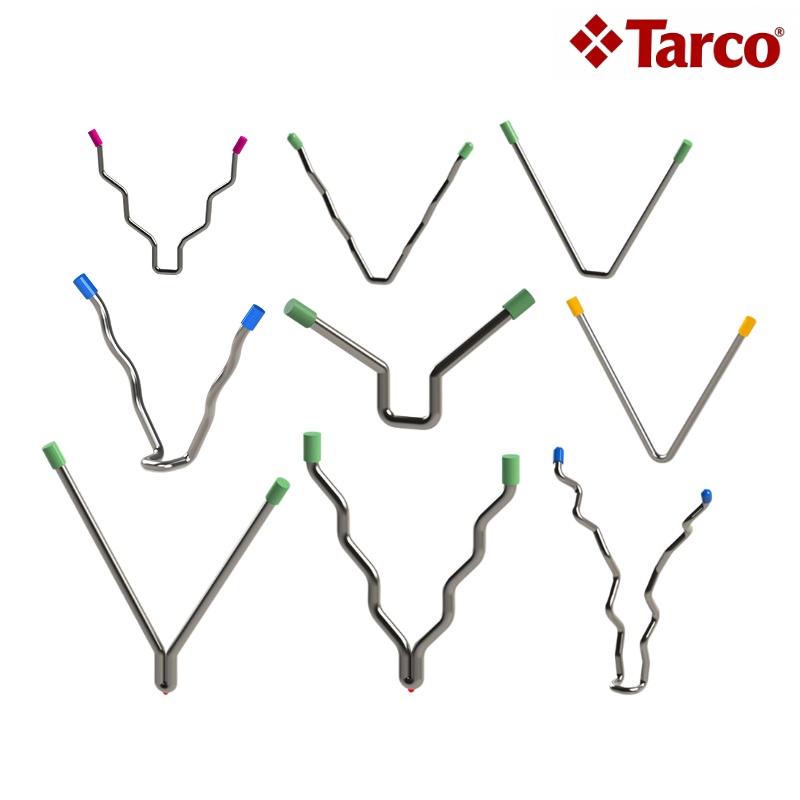
Refractory Castable Anchors — V, Y & Crook Type for Furnace & Kiln Linings
Basically, a refractory castable anchor is a metallic fastener welded to the steel shell of a furnace, kiln or reactor. Then, workers pour or gun castable refractory around it. Additionally, the anchor holds the monolithic lining in place during thermal cycling. Therefore, Tarco Industry manufactures V-type, Y-type, crook and custom-shaped castable anchors from 5–16mm diameter bar in SS304, SS310, SS316, SS321 and Inconel 601. Furthermore, we can make them to your drawing. Also, our factory is ISO 9001:2015 certified.
V / Y / Crook Types
Bar Diameter: 5–16mm
Max Temp: 1200°C
Custom-Made to Drawing
What Are Refractory Castable Anchors?

Indeed, refractory castable anchors are the backbone of monolithic refractory linings. First, workers weld a V-shaped, Y-shaped or crook anchor to the steel shell. Next, they cast or gun the refractory material around the anchor. As a result, the anchor grips the castable from within — stopping it from sagging, cracking or breaking away during thermal cycling. Moreover, castable anchors control cracking and accommodate thermal expansion and vibration.
Additionally, castable anchors specifically suit medium-to-thick monolithic linings where heavy holding power is required. They are quick to install by stud welding and protect the lining by stopping crevices from forming, which could lead to spalling or hot-spot corrosion. However, manufacturers can produce the same anchor geometry in Inconel 601 or Incoloy 800 when a higher-temperature grade is needed — for example in reformer or incinerator service above 1100°C.
For strict quality assurance, our refractory castable anchor production follows ASTM standards. You can also view our full range of refractory anchors or contact Tarco Industry directly for custom requirements.
Refractory Castable Anchor Types
V-Type Castable Anchor
Two legs diverge from a central stem. We recommend V-type anchors for thin-to-medium castable linings in furnaces and boilers. The simple geometry allows for secure mechanical anchorage without complicating installation.
Y-Type Castable Anchor
A single stem with two diverging legs at the top. Specifically, Y-type anchors provide deeper anchorage for medium-to-thick monolithic refractory. They suit cement kilns, reformers and incinerators.
Crook Castable Anchor
A single-leg hook shape. Furthermore, crook anchors work best for thinner castable linings and ceramic-fibre systems where heavy holding power is not required.
Custom Castable Anchors
Additionally, we manufacture asymmetric crooks, U-types, corrugated designs and two-part anchors to your drawing. You can customise bar diameter, leg length, angle and tip profile.
Refractory Castable Anchor Specifications
| Product Name | Refractory Castable Anchors / Castable Refractory Anchors |
|---|---|
| Anchor Types | V-type, Y-type, Crook, U-type, Corrugated, Custom-shaped |
| Material Grades | SS304, SS304L, SS310, SS310S, SS316, SS316L, SS321, SS330 Inconel 600, Inconel 601, Inconel 625 Incoloy 800 / 800H / 800HT Duplex 2205, 2507; Monel 400; Hastelloy C276 |
| Bar Diameter | 5mm – 16mm (standard); other diameters on request |
| Anchor Length | 50mm – 300mm, or as required for lining depth |
| Anchor Spacing | Typically 150mm – 300mm, based on lining design |
| Max Service Temperature | SS304/316: ~800°C · SS310: ~1100°C · Inconel 601: ~1200°C |
| Surface Finish | Bright, pickled, or as-welded |
| Certification | ISO 9001:2015; Mill Test Certificate / NABL approved test certificate available |
| Customisation | We custom-make to drawing — any bar size, length, angle or material |
Castable Anchor Material Selection Guide
For example, choosing the correct material for your refractory castable anchor is the single most important decision for anchor service life. The anchor sits inside the lining, close to the hot face. Consequently, it must retain its strength against oxidation, scaling and thermal fatigue.
SS 304 / 304L
Up to ~800°C
We recommend SS 304 / 304L for low-to-medium temperature castable linings, ducts and stacks. This general-purpose stainless steel offers good corrosion resistance and weldability at a budget-friendly cost.
SS 310 / 310S
Up to ~1100°C
In contrast, SS 310 is the standard choice for most industrial furnace castable anchors. Its high chromium and nickel content delivers excellent oxidation resistance under cyclic heating conditions.
SS 316 / 316L
Up to ~870°C
Specifically, we recommend SS 316 / 316L for places with chlorides or reducing acids. This molybdenum-bearing grade is preferred where corrosion resistance is the primary concern.
Inconel 601
Up to ~1200°C
Furthermore, this nickel-chromium alloy features an aluminium addition for outstanding oxidation resistance at the highest temperatures. Additionally, it resists carburisation and sulfidation — making it ideal for reformers, incinerators and petrochemical heaters.
Refractory Castable Anchor Applications
For instance, refractory castable anchors are used across high-temperature industries wherever a monolithic lining needs mechanical retention:
- Furnace linings — petrochemical process furnaces, heaters, stacks, breechings
- Kiln linings — cement rotary kilns, lime kilns, ceramic kilns
- Castable refractory — gunned or poured monolithic linings over V, Y and crook anchors
- Reformers & incinerators — Inconel 601 castable anchors for 1100–1200°C service
- Boiler & duct insulation — medium temperature linings in power plants
- Reactors & process vessels — abrasion-resistant and heat-resistant monolithic linings
- Steel industry — ladle, tundish and torpedo car linings
Castable Anchor Installation & Ordering
Generally, installers use stud welding to attach castable anchors directly to a clean, brushed area of the steel shell. Standard stud welding with a ceramic ferrule is the most common method. Subsequently, workers weld each anchor once, with the V or Y legs pointing outward into the lining cavity. Also, they may use manual arc welding for larger-diameter bars or field repairs.
To order, first specify: anchor type, material grade, bar diameter, anchor length and quantity. Additionally, we can manufacture custom geometries — including asymmetric designs and two-part anchors — to your drawing. Consequently, our standard lead time is 2–4 weeks; however, custom anchors take 3–6 weeks depending on material availability.
Request a Quote for Refractory Castable Anchors
Send us your drawing, anchor type, material grade and quantity. We will respond within 24 hours with pricing and lead time.
Refractory Castable Anchor FAQ
What is the difference between a castable anchor and a ceramic fibre anchor?
What material should I use for a castable lining at 1150°C?
Can castable anchors be made to custom dimensions?
Do you provide mill test certificates for castable anchors?